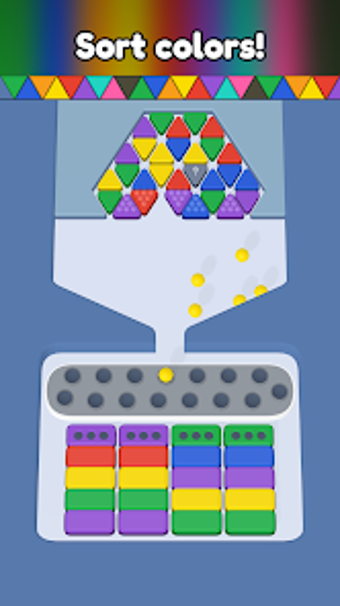
Triangle Sort: a precise, meditative marble-routing puzzle
Triangle Sort, developed by Arizona GS, is a mobile puzzle about routing and capacity management using colored marbles on a moving belt. Players release marbles into a closed-loop conveyor to fill sockets in the correct sequence, with physics-based movement and no timers. The game offers 30 hand-built levels, nine color-checked marbles, and an under-the-machine camera; it targets casual puzzle players who prefer logic-driven, one-handed Android play and offline accessibility.
How Triangle reframes sorting puzzles with risk-driven sequencing
The game positions itself against conventional match-and-fill titles by using a closed-loop belt system that contains exactly the number of marbles required, creating a "zero-margin" puzzle design where every marble matters. That design makes sequencing the core loop: tap blocks to release marbles, watch them funnel into the belt, and time drops to match open sockets. The result emphasizes planning over speed, supported by the absence of timers.
What modes and mechanics define player decisions
The app is single-player and focuses on routing, capacity, and timing rather than additional modes. Mechanics include physics-based marble settling and a fifteen-slot conveyor that can deadlock if non-matching marbles fill every slot. Levels are hand-built and verified for solvability, which frames each stage as a fixed logical puzzle rather than a randomized challenge.
What the visuals, audio, and interface communicate to the player
The camera looks up from beneath the machine, giving a mechanical, investigative perspective that highlights chute geometry and socket placement. Portrait orientation supports one-handed play on Android, and nine marble colors have been checked against common color-vision deficiencies to aid readability. Visual clarity and the sound of marbles settling reinforce a meditative atmosphere while keeping focus on spatial relationships.
How difficulty, progression, and replayability behave
Progression comes through thirty progressively arranged levels; each is solvable but demands precise sequencing because there are no spare marbles. The lack of timers shifts difficulty toward logical planning, and deadlock mechanics encourage restarts rather than trial-and-error with extra pieces. Offline functionality permits repeated practice without connectivity, which supports short or extended puzzle sessions.
In summary, Triangle Sort rewards deliberate planners more than speed seekers
Triangle is a measured choice for players who enjoy logic-first puzzles and dislike time pressure, because every level requires exact sequencing and contains no spare pieces. Players who prefer large-mode variety or competitive modes may find the single-player, level-based design limiting. In summary, Triangle suits those who want quiet, exacting puzzles that test planning under fixed constraints.